
- calendar_today August 8, 2025
.
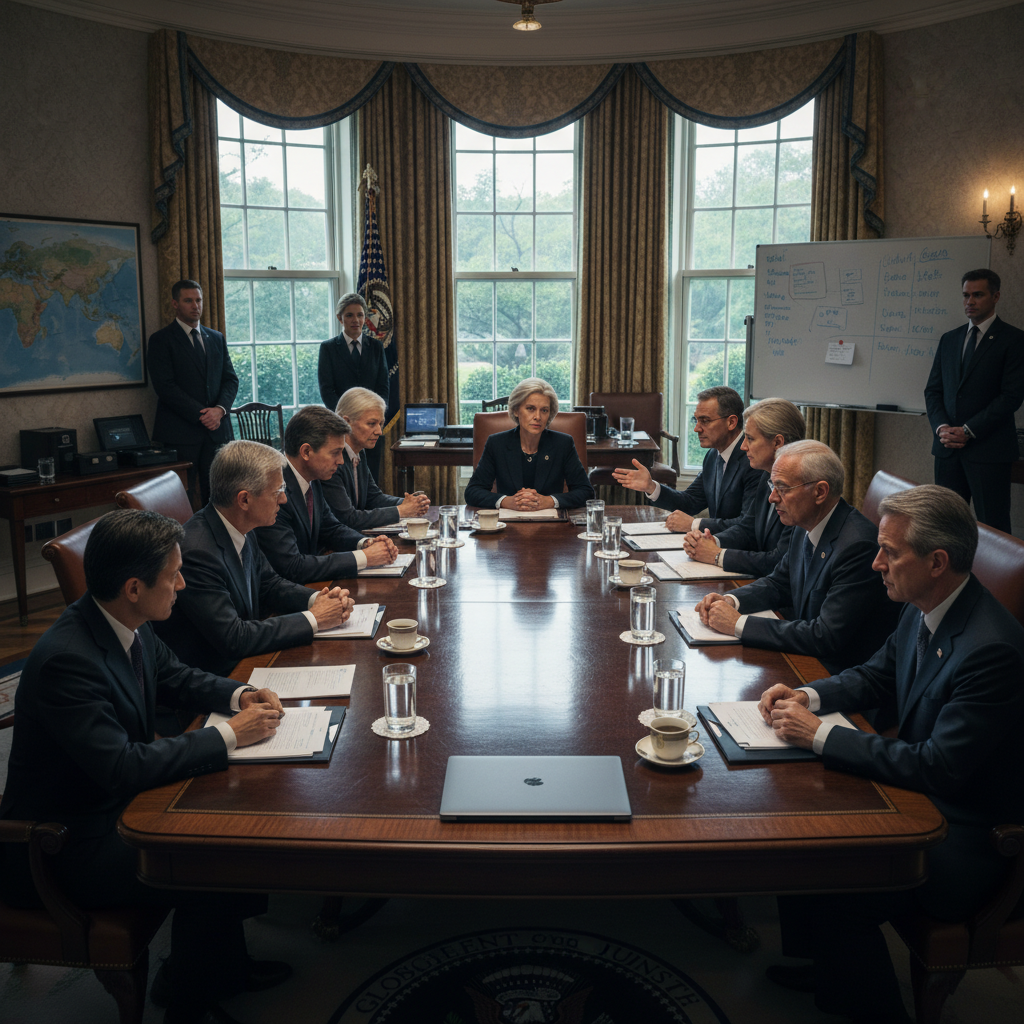
President Donald Trump is once again touting his foreign policy record and even claiming credit for ending six wars as he kicks off his second term in the White House. The braggadocio on Monday came during a meeting with Ukrainian President Volodymyr Zelensky and European leaders, in which the U.S. president also mused that he was close to bringing an end to the war in Ukraine.
“I’ve done six wars — I’ve ended six wars,” Trump said, listing conflicts in the Middle East, Africa and Asia. “Look, India-Pakistan, we’re talking about big places. You just take a look at some of these wars. You go to Africa and take a look at them.”
Trump’s self-aggrandizing claim came in a meeting with Zelensky, who Trump pushed out the now-disgraced Ukraine President Volodymyr Zelensky last year in the bid for an investigation into his domestic political rivals. While in the White House, Trump’s team also published a statement branding him the “President of Peace” due to agreements or initiatives between Armenia and Azerbaijan, Cambodia and Thailand, Israel and Iran, Rwanda and the Democratic Republic of the Congo, Egypt and Ethiopia, and Serbia and Kosovo. The administration also touted the Abraham Accords, signed during Trump’s first term, which established diplomatic and commercial ties between Israel and four Arab nations.
Loose Ceasefires, No Treaties
Analysts noted that while Trump was claiming credit for these diplomatic breakthroughs, many were tenuous ceasefires and by no means permanent peace treaties. In the case of Israel and Iran, Trump claimed to have “done peace,” following a 12-day conflict between the two. However, relations remain frosty due to a lack of progress on Tehran’s nuclear program and decades of mutual hostility.
Other claims of success were more fanciful. Trump’s effort to broker a cease-fire between Israel and the Hamas terror group in the Gaza Strip failed, as did first-term outreach to North Korean dictator Kim Jong Un, which saw Pyongyang expand its nuclear arsenal.
One of Trump’s more recent “wins” was a peace declaration signed last week between Armenia and Azerbaijan, which the White House hosted on its South Lawn. The agreement, which will see both sides recognize borders and renounce violence, also opens up a U.S.-controlled transportation corridor, which was heralded as the “Trump Route for Peace and Prosperity.” Azerbaijani President Ilham Aliyev called it “a miracle.”
Trump also exploited trade threats to end a border clash between Cambodia and Thailand that left 38 people dead, according to one count. Although the Association of Southeast Asian Nations (ASEAN) deserves some of the credit, Cambodian Prime Minister Hun Manet singled out Trump as the negotiator and nominated him for the Nobel Peace Prize.
The South Asia case is more mixed. Trump again claimed credit for de-escalating a border clash between nuclear-armed India and Pakistan in May. While Islamabad praised U.S. involvement, New Delhi did not. Although the two sides agreed to a truce, the underlying dispute over the Kashmir region was not resolved, calling the deal’s durability into question.
The African case points to another trend in Trump’s peace-making: to what extent his deals are meant to gain a wedge over China, which is also seeking to expand its influence on the continent. Trump has particularly pointed to an agreement between Rwanda and the Democratic Republic of the Congo to disarm militias and ease tensions along their border. However, the M23 rebel group that is at the heart of the violence was not part of the process and rejected the accord. Many analysts think the U.S. government’s motivations for getting involved include curbing Chinese influence over Africa’s mineral resources.
A closer look also shows that Trump’s claim about Egypt and Ethiopia is more aspirational. While he has put pressure on the two sides to agree on how to share the resources of a major Nile dam project, a binding agreement has yet to materialize. In the case of Serbia and Kosovo, which Trump is again taking credit for, the deal he is spotlighting was a first-term effort to get both sides to take concrete steps toward economic normalization. However, the two nations still lack full diplomatic ties, and most of the recent negotiating has taken place under the auspices of the European Union.
Critics of Trump argue that his dismantling of large parts of the State Department and evisceration of the U.S. Agency for International Development will hamstring efforts to turn ceasefires into sustainable peace. Others say his unorthodox approach to peace-making, with its reliance on personal branding and even bluster, has had at least some short-term success.
One expert on South Asia, Celeste Wallander, who was an assistant secretary of defense under the Obama administration and now works at the Center for a New American Security, said Trump’s quiet diplomacy between India and Pakistan was the most successful aspect of his intervention in the region. “The ones that were helpful … were conducted in a professional way, quietly, diplomatically, in a low-key way, finding common ground between the parties,” Wallander said.
Trump’s Ukraine Efforts Questioned
Now Trump is working to extend his self-styled peace-making role in the conflict between Russia and Ukraine, musing last week that “I think it’s going to end soon, I really do.” But critics question his ability to reach a lasting agreement that does not sacrifice Ukraine’s sovereignty to Russian aggression, as he did last year when he pushed out Zelensky to extract information that could hurt his political opponents.
Ukraine’s Zelensky attended Monday’s meeting with Trump at the White House, along with European leaders, after he took part in a demonstration against the Russian war against his country. Trump mused Monday that he might be able to bring the Russian invasion of Ukraine to an end soon. “I have a feeling that it’s not going to last too much longer,” he said.