
- calendar_today August 10, 2025
LA’s Museum of Jurassic Technology scorched but survives
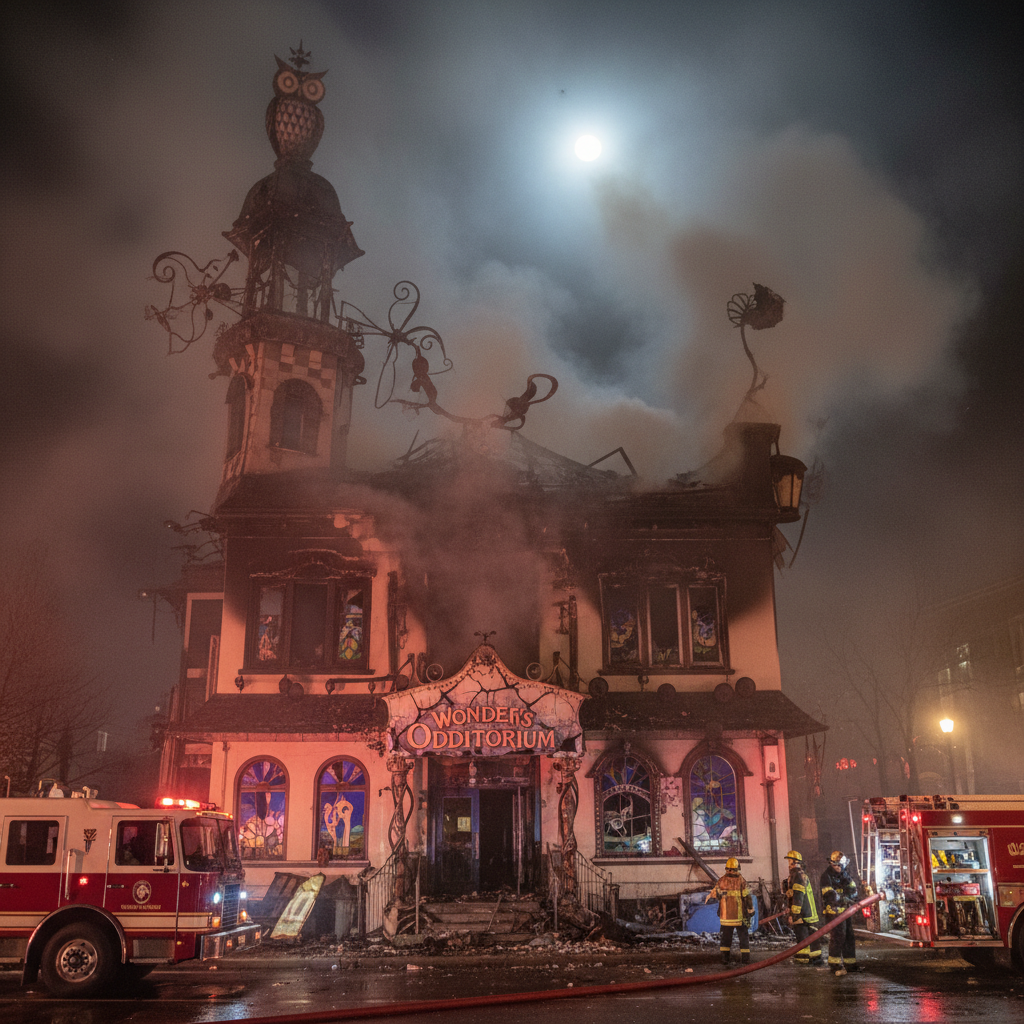
In the latest bit of bad news for Los Angeles’ cultural scene, one of the city’s weirdest institutions, the Museum of Jurassic Technology (MJT) in Culver City, suffered significant damage after a fire broke out in the early morning hours of July 8. Fortunately, no one was hurt, and most of the building’s damage is believed to have been limited to the MJT’s gift shop, as well as smoke damage throughout several exhibits. The museum anticipates losses in revenue during its closure of about $75,000 and expects to reopen sometime next month.
A Cultural Institution
For years, the MJT has occupied a strange but revered place in LA’s cultural firmament. The museum, which opened in 1988 and was founded by David Hildebrand Wilson and Diana Drake Wilson, has long been known for its intentionally confusing and at times dubious exhibits. The museum claims to be “dedicated to the advancement of knowledge and the public appreciation of the Lower Jurassic,” but in actuality, there’s little about the Lower Jurassic on display. Instead, the MJT, which has been called a cabinet of curiosity (or wunderkammer in German), owes much of its inspiration to the early, Renaissance-era precursor to the modern museum.
In the years since its opening, the MJT has developed a cult following for its layered storytelling, which, while at times offering up factual historical artifacts and figures, often walks a line of truth and fiction so thin that many visitors leave with a hard time discerning what’s real and what’s not. As such, the museum offers exhibits ranging from a celebration of the works of the actual 17th-century polymath Athanasius Kircher to displays of ultra-miniature sculptures so small that they are only on display inside the eye of a needle and were sculpted from a single human hair, all in the name of the Armenian artist Hagop Sandaldjian.
Eccentric as they come
Other exhibits have veered even further into the off-kilter. One room contains decomposing dice collected from the world’s most famous magician, Ricky Jay, while another offers a visual history of Los Angeles-area trailer parks in a display called “The Garden of Eden on Wheels.” Other MJT rooms and displays include stereographic radiographs of flowers, microscopic mosaics assembled from butterfly wing scales, and an assortment of letters written by amateur astronomers to the Mount Wilson Observatory in the years 1915 to 1935. Since 2005, the museum has even maintained a Russian tea room that is “modeled on Tsar Nicholas II’s study in the Winter Palace of St. Petersburg.”
Firefight and Aftermath
In a lengthy account of the fire’s aftermath published on Saturday by writer Lawrence Weschler, whose 1996 book Mr. Wilson’s Cabinet of Wonder unpacks the provenance of many of MJT’s pieces, we learn that the fire was first spotted by none other than David Wilson himself, who lives in a residence behind the museum’s building. The fire, which had started in the building around 2:00 am, was quickly noticed by Wilson, who was first outside the museum with two fire extinguishers. “A ferocious column of flame” is how Wilson described the building to Weschler later that day, saying the blaze had climbed the corner wall on the building’s street-facing side.
Wilson and his extinguishers couldn’t put out the blaze, but he and the staff and volunteers had only seconds to react. Wilson’s daughter and son-in-law, arriving just as Wilson had, had a larger extinguisher that helped subdue the flames until firefighters arrived on the scene, who later told Wilson that the museum would have “gone if they had been a minute late.”
While the damage was mostly limited to the gift shop, smoke damage was felt throughout the museum. Wilson said later that the smoke damage reminded him of “a thin creamy brown liquid… evenly poured over all the surfaces—the walls, the vitrines, the ceiling, the carpets, and eyepieces, everything.” Wilson told Weschler that the smoke damage is especially difficult to clean, and while the staff and volunteers had started cleaning and repairing the smoke damage, the process was slow and would take time. In the meantime, Weschler has been encouraging contributions to the museum’s general fund.
Weschler noted that this is one of the most truest times when a museum like the MJT, “one of the most truly sublime institutions in the country, one of the last remaining places in which to encounter wonder that lies not this or that side of some imaginary line dividing science from art or scholarship from invention or even truth from fable” needs support. While the museum’s reopening date is still up in the air, most are optimistic that the museum will make a full recovery, its delicious mixture of satire and scholarship just as strong as before.