
- calendar_today August 6, 2025
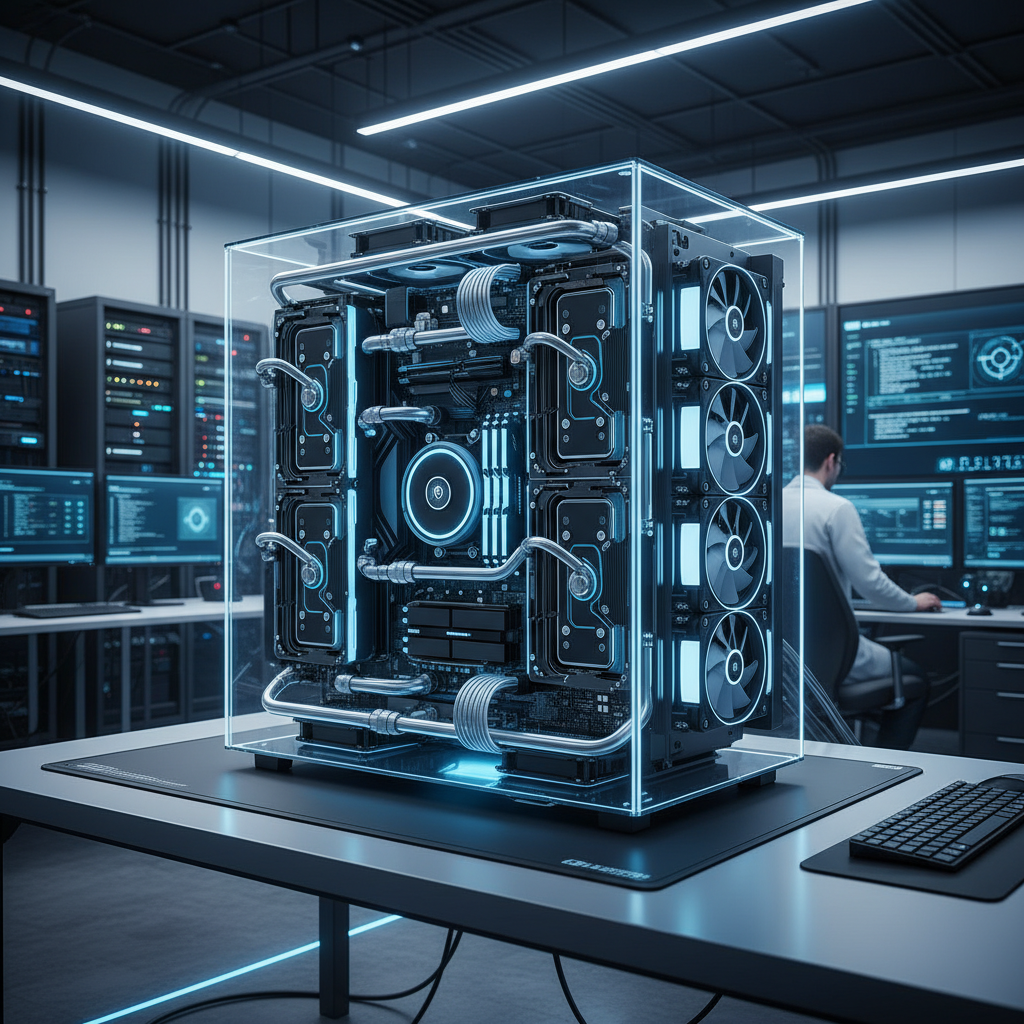
Desktop computing has experienced a paradigm shift as Nvidia released the DGX Spark and DGX Station which serve as “personal AI supercomputers.” CEO Jensen Huang announced a transformative development at the Nvidia GTX keynote which enables developers, researchers, and data scientists to access superior AI capabilities from their own workstations. The systems have been carefully engineered to support local prototyping and execution of sophisticated AI models while allowing for fine-tuning which represents a significant advancement in making AI development more accessible.
The Grace Blackwell Platform: Architecting the Future of AI
Foundation of Innovation: The groundbreaking Grace Blackwell platform forms the foundation of the DGX series. The architecture is specially constructed to meet the demanding computational needs of today’s neural networks. The design completely breaks away from traditional PC architecture to create a novel computer category that is optimized specifically for AI-native applications. Huang explained that AI has changed every level of the computing stack. The emergence of a new computer category should occur because these devices will be created for AI-native developers to run AI-native applications.
Power and Performance: DGX Spark and DGX Station Detailed
DGX Spark: Compact Power for AI Development:
The DGX Spark stands out as the more streamlined option among them and operates with the GB10 Grace Blackwell Superchip as its power source. Through the integration of a Blackwell GPU with fifth-generation Tensor Cores the chip achieves 1,000 trillion operations per second for AI workloads. This performance level equips users with the ability to execute complex AI tasks at exceptional speed and efficiency which makes it perfect for rapid prototyping and model development.
DGX Station: Unleashing Ultimate Performance:
The DGX Station delivers the highest level of computational performance with its GB300 Grace Blackwell Ultra Desktop Superchip. The system offers 784GB of coherent memory alongside the ConnectX-8 SuperNIC which achieves networking speeds reaching 800Gb/s. By delivering peak performance capabilities this setup enhances complex AI application development alongside research initiatives.
Streamlining AI Workflows: Bridging Local and Cloud Environments
Seamless Integration: The DGX systems once called “Project DIGITS” serve functions beyond simply operating as high-performance desktops. These systems operate as independent AI laboratories that allow developers to move AI models from local development environments to DGX Cloud or compatible AI cloud infrastructure with minimal code changes. The “bridge system” feature enhances the AI development workflow by providing developers with greater flexibility and efficiency through hybrid environment support.
Expanding Accessibility: Collaborative Manufacturing and Market Dynamics
Strategic Partnerships: The DGX architecture stands as an open framework that allows top PC manufacturers to create their unique versions. The companies Asus, Dell, HP, and Lenovo are developing and selling DGX systems. The production of the DGX Station will benefit from contributions by BOXX, Lambda and Supermicro. The collaborative approach creates greater accessibility and various configurations which serve a broad range of user needs.
Pricing and Availability: Democratizing AI Supercomputing:
The final pricing details remain undisclosed due to multiple manufacturers’ involvement but Nvidia has shared that a DGX Spark-like system’s base configuration will come with an approximate cost of $3,000. The combination of competitive prices and powerful DGX system features makes them an ideal choice for AI professionals looking to enhance their development capabilities.
Customers can instantly book DGX Spark showing its immediate accessibility as a powerful tool. The DGX Station promises increased performance capabilities and should launch later this year in 2025. The DGX desktop series from Nvidia makes AI supercomputing accessible to everyone and enables new innovators to develop the future of artificial intelligence.